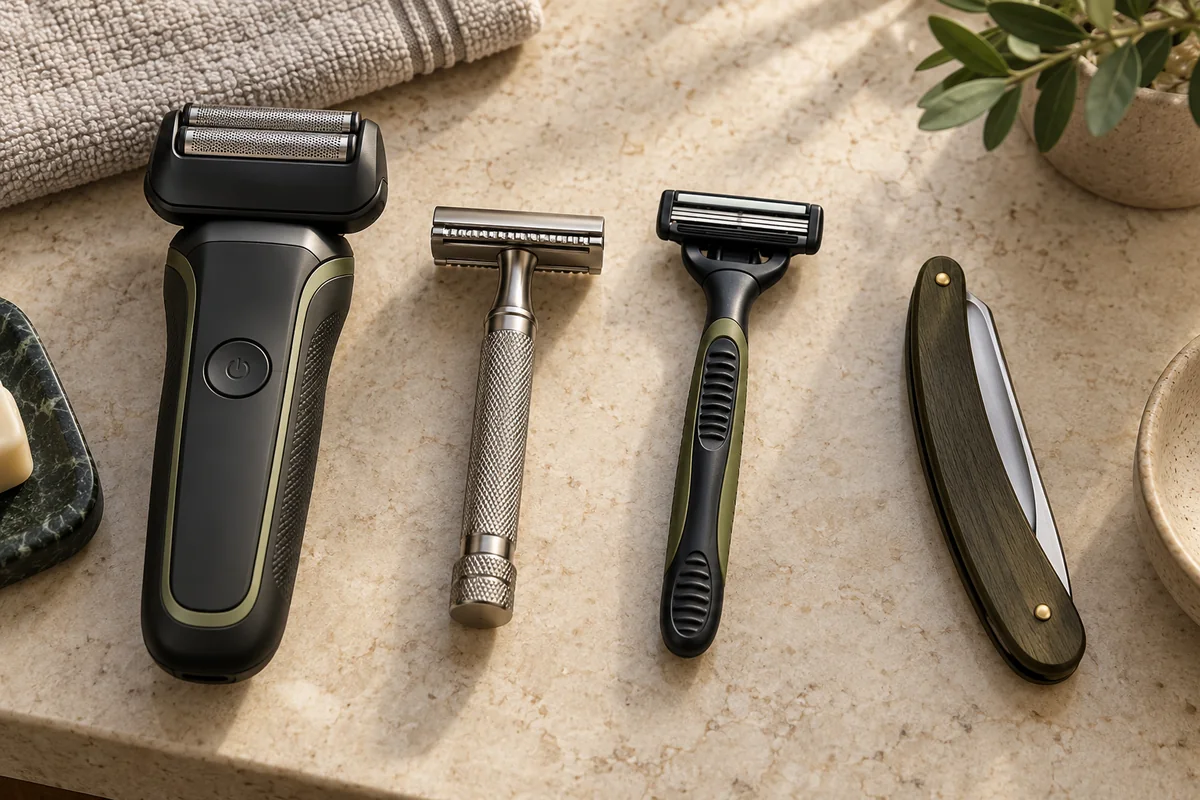
Choose by the finish you want and the response of your skin. A guarded trimmer keeps stubble; foil, rotary, and wet razors aim closer. Start with gentle technique, read your model's manual, and leave more length if close shaving repeatedly causes bumps.
The right razor is the one that reaches your chosen finish without making your skin pay for extra closeness. Start with the look you want, the time you will spend caring for the tool, and what your skin has done after previous shaves.
Quick answer: choose the finish before the razor
For visible stubble or a maintained beard, begin with a guarded trimmer. For a clean-shaven look, compare a foil or rotary electric with a wet razor you can use gently. If close shaving repeatedly brings painful bumps, leave deliberate length and use the razor-bump guide before chasing another blade. A safety or straight razor is a choice to learn a particular technique, not a guaranteed skin upgrade.
AAD’s basic shaving advice emphasizes softened hair, shaving cream, following hair growth, a sharp blade, and rinsing after each stroke. Its skin-care guidance suggests trying one or two blades if multiple blades cause bumps. That is a practical starting point, not proof that one blade count works best for everybody.
Compare the tools without a universal winner
| Tool | Finish it aims for | Learning and care | Skin-response check |
|---|---|---|---|
| Guarded beard trimmer | Deliberate stubble or an even beard length; a guard keeps the cutter from aiming for skin-level smoothness. | Match the guard to your model, start longer, and clean and maintain it by its manual. Detail work may need another attachment. | A useful first experiment when a close shave triggers bumps. Trimming can still irritate, so stop if the head snags or presses into inflamed skin. |
| Foil electric shaver | Clean-shaven appearance using a guarded cutting head, with a different feel from a wet blade. | Learn the model’s stroke pattern, cleaning, head replacement, and whether it permits wet use. Some foil models use straight strokes. | Try light pressure and fewer repeat passes. An electric tool can still irritate; do not assume it is automatically safer for every face. |
| Rotary electric shaver | Clean-shaven appearance with circular cutting heads that move over facial contours. | Many models call for gentle circles; wet use and cleaning rules vary. Read the exact manual before adding water or cream. | Compare comfort on your difficult neck patches. If circles mean repeated passes over sore skin, stop and change the finish. |
| Cartridge razor | A wet, skin-close shave with a replaceable cartridge on a reusable handle. | Simple setup; rinse the head during shaving, replace a dull cartridge, and let it dry between uses. | A close result may suit some people and cause bumps in others. If a multiblade head repeatedly shaves too close for you, try less closeness or another tool. |
| Disposable razor | A wet shave with a handle and head discarded together when the blade is spent. | Low setup burden; still requires shaving cream, careful strokes, dry storage, and timely replacement. | Convenience does not make a dull blade harmless. AAD advises replacing disposable razors after about five to seven shaves to limit irritation. |
| Safety razor | A wet shave with a replaceable exposed-edge blade held in a protective head. | More attention to blade loading, angle, pressure, and safe disposal; the exact razor manual governs assembly and use. | A single cutting edge is an option to try when a multiblade head bothers your skin, but it can nick or irritate with poor technique. |
| Straight razor | A traditional wet shave and precise edge control with a fixed blade; a replaceable-blade shavette is a different tool. | Highest practice and care burden here: blade handling, stropping, drying, and eventual honing. Learn the maker’s instructions before use. | Choose it for the method if you want to learn it, not for a promised closer or bump-free shave. Do not use it to shave over active bumps. |
Blade-count reality check: A September 2026 dermatology expert consensus reached no agreement on multiblade razors for pseudofolliculitis barbae (razor bumps). This guide therefore does not rank blade counts or claim that a safety, cartridge, or electric tool treats a skin condition. The table describes how tools are designed and what to observe when trying them, not comparative clinical outcomes.
How to shave for the beard you want
| Your look | Useful first tool | Where to use a closer tool, if needed |
|---|---|---|
| Clean-shaven | Foil or rotary electric, or a wet razor you already use comfortably. | Map the grain and start with one gentle with-grain wet-blade pass. Reassess before adding any pass; smoothness in every direction is optional. |
| Intentional stubble | Guarded trimmer, beginning at a longer setting. | Only outside the cheek or neck boundary if you want a sharper outline. The stubble itself should not be shaved down to skin. |
| Shaped beard or goatee | Trimmer and detail attachment for the kept hair and the intended outline. | Shave exposed areas around that outline using their local grain, with light pressure and minimal repeat passes. |
| Full beard | Trimmer or scissors for length and flyaways; comb to assess the dry shape. | Only the stray hair beyond a chosen edge, if any. Cleanse and moisturize the beard and skin beneath it. |
Let the areas that actually grow densely help determine the outline. AAD advises choosing a style around sparse or patchy areas; shaving a patch does not make it grow back thicker. The neckline guide and cheek-line guide help place the boundary before you remove hair.
A routine that works across the choices
- Choose the target. Decide whether the goal is retained length, a clean-looking face, or an edge. Do not switch to a closer finish just because one patch feels rough when rubbed against its growth.
- Read the tool’s manual. Electric and guarded tools differ in wet/dry rating, stroke direction, cleaning, guard fit, and replacement parts. For example, Braun’s foil guidance describes holding the head at a right angle and moving against growth, while a Philips rotary manual calls for gentle circles. Neither instruction applies to every device or overrides a skin response that calls for a less-close finish.
- For a wet blade, soften and lubricate. Wet the hair, use shaving cream or gel, and map growth before lather hides it. Use a sharp blade, short light strokes with the local grain, rinse after each stroke, and avoid stretching skin for extra closeness. The grain guide has a printable map.
- Stop at comfort. Rinse, look in ordinary light, and avoid shaving over a painful bump or acne lesion. Moisturize the just-shaved skin; clean and dry the tool as its maker directs. If the razor tugs or the skin stings, do not answer by pressing harder.
For recurring ingrown hairs, a Mayo Clinic care guide suggests an electric razor or clippers set away from the closest shave, in addition to with-grain technique for manual blades. Persistent, worsening, or painful bumps deserve a qualified skin assessment rather than another razor purchase.
What to check before buying or replacing a tool
- Finish: Does it leave the length you actually want, including on the neck?
- Fit: Can you see and control the head at the jaw curve and your chosen beard boundary?
- Care: Are compatible blades, cartridges, foils, guards, or replacement heads available? Will you follow the cleaning and drying routine?
- Skin history: Did the last tool cause tugging, sting, nicks, or bumps later? Change one variable at a time so the next shave tells you something useful.
Do not treat price, blade count, or a manufacturer’s comfort claim as a substitute for your own result. This page has no current price comparison or hands-on product testing.
Primary source ledger
- American Academy of Dermatology: How to shave — prep, direction, blade changes, and storage.
- American Academy of Dermatology: Skin care for men — trying fewer blades when a multiblade razor causes bumps and moisturizing after shaving.
- American Academy of Dermatology: A healthy beard — washing, moisturizing, trimming, and shaving neck hair with its growth.
- Mayo Clinic: Ingrown hair — mechanism and less-close electric or clipper option.
- JAMA Dermatology: 2026 expert consensus on razor bumps — no consensus on multiblade razor use. This is expert consensus, not a comparative product trial.
- Braun: Foil shaver guidance and Philips: Rotary shaver manual — examples of electric technique; these manufacturers do not establish a universal medical winner.
- Mühle: Safety razor manual and DOVO: Straight razor care — examples of the different handling and maintenance burdens.
Evidence limits: tool categories and manufacturer instructions help frame a purchase, while individual comfort must be observed. Clinical research does not establish a universal best razor, pass count, or shave schedule for every beard and skin type. The style matrix and buying checklist are Beard Insider editorial synthesis. Sources checked October 20, 2026.
Review and corrections note
Source-check status: October 20, 2026. Clinical-review status: No named clinical review or hands-on product testing. Product formulas, labels, regulations, and medical guidance can change. Report a factual problem or changed source, or read the public research update log.