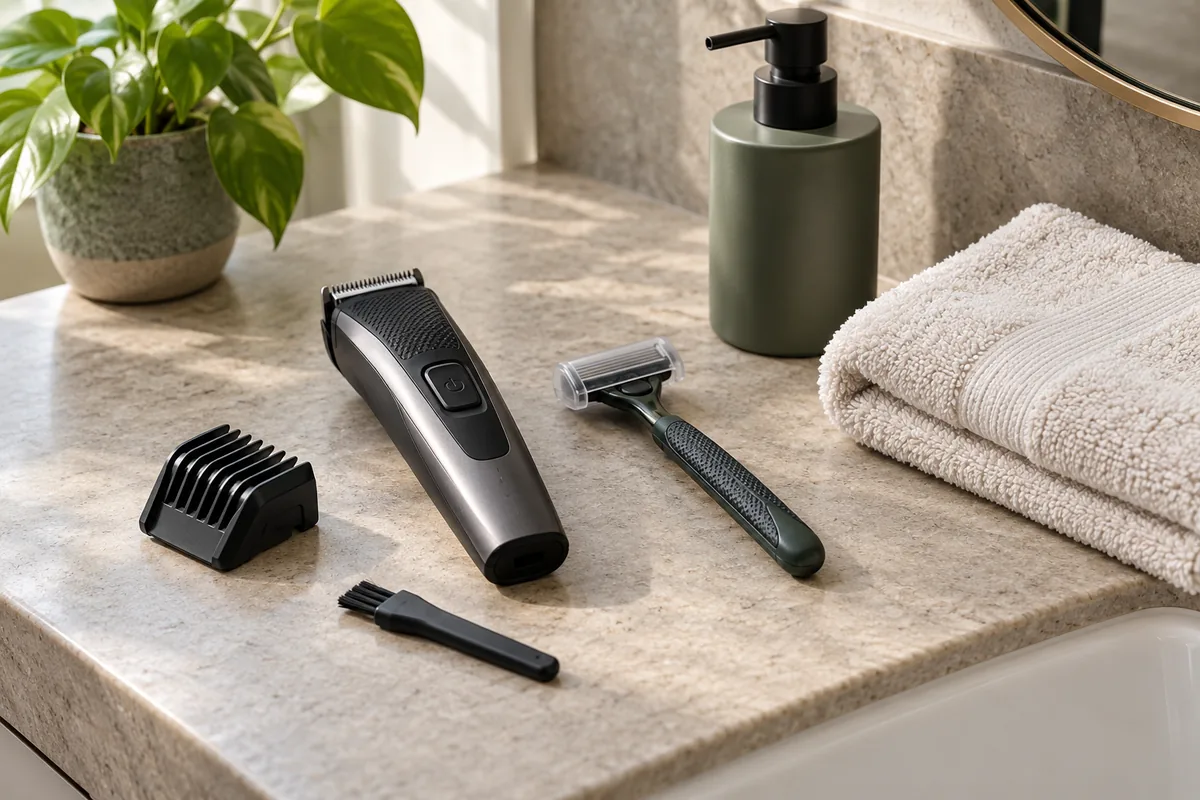
Start switched off and disconnected. Brush away hair, use water only on the parts your exact model permits, air dry fully, and oil only as its manual requires. Protect the dry blades before storage and keep the charger separate from cleaning.
A trimmer that looks clean can still hold clipped hair beneath the comb. The useful routine starts with the model number: identify which parts may get wet, remove debris, let approved washable parts dry, and lubricate only as that tool requires.
Quick answer: how should you clean a beard trimmer?
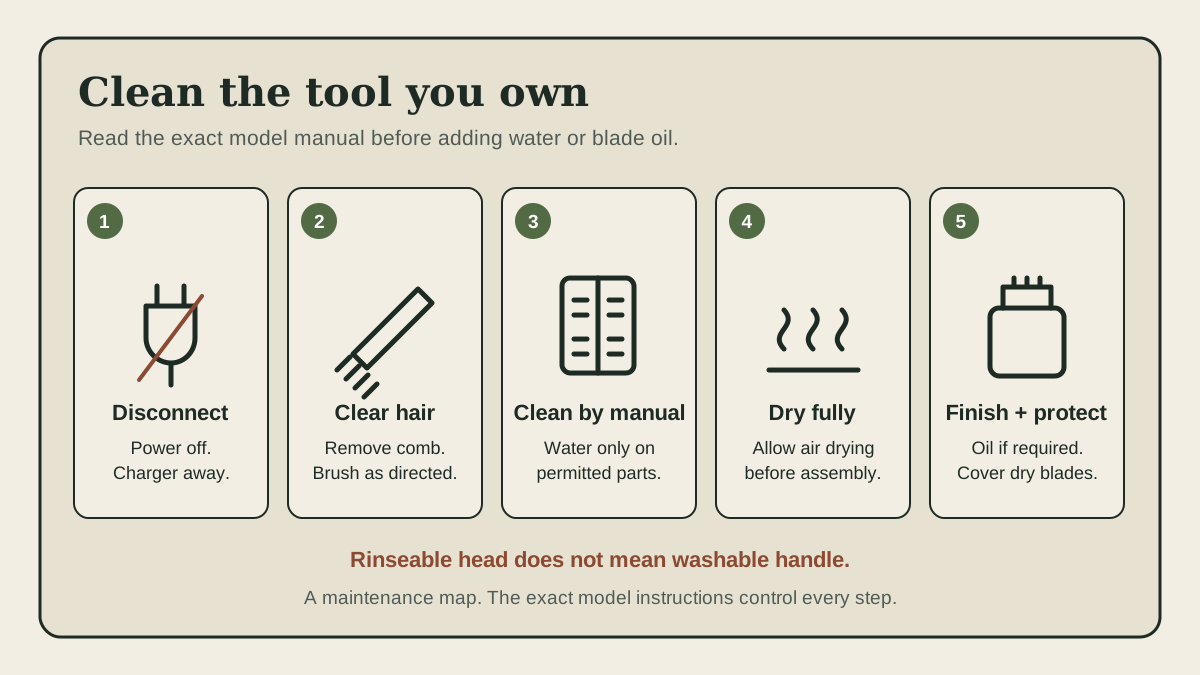
Start with the trimmer switched off and disconnected from its charger. Remove the comb and brush away loose hair as the manual directs. Use water only on the parts your exact model allows, air dry those parts completely, then follow its blade-oiling instructions. Reassemble and protect the dry blades before storage. A removable head, cordless battery, or stainless-steel blade does not by itself establish that the handle is washable.
First decide what can get wet
Find the full model identifier on the device or its documentation and open the matching manufacturer manual. Check the cleaning section for the handle, detachable cutter, comb, charging socket, and adapter separately. Philips explains where to find its model number; Wahl provides a manual lookup route.
| What the instructions say | What to do | What you cannot assume |
|---|---|---|
| Brush cleaning only / non-washable | Use the supplied cleaning brush on the specified areas. | A detachable blade is automatically rinseable. Wahl’s clipper FAQ explicitly prohibits water on the blades it describes. |
| Washable attachments, dry body | Remove and rinse only the permitted components; keep the main unit dry. | Water permission transfers from the head to the handle. Panasonic’s ER-GB370 instructions separate them. |
| Washable device / tap symbol | Follow the exact rinse method. | Tap washing means shower use or immersion. Philips distinguishes washable devices from showerproof ones. |
| Showerproof / wet-and-dry device | Follow its water-use and cordless-use limits. | The adapter or charging stand has the same water protection as the trimmer. |
These are examples, not brand-wide rules. Compare Philips cleaning categories, Panasonic’s model-specific cleaning steps, and the Wahl clipper FAQ. If you cannot establish water permission, keep water away until the manufacturer confirms it.
A repeatable routine after trimming
- Disconnect and remove the comb. Begin switched off, unplugged, and away from the charger. Remove the cutter only if the manual describes it as user-removable. Some manuals specify a brief cordless running rinse; that is a model-specific exception, not permission to clean a plugged-in tool.
- Clear the hair. Brush the comb, accessible blade area, and hair chamber as directed. Do not force apart the housing or pry between cutting teeth. Philips says the white grease on the drive pin of many models is intentional: leave that grease in place and do not add lubricant to the pin.
- Clean through the approved route. Follow the manual’s brush-only or water method. Do not substitute dish soap, solvents, or a household disinfectant for the specified process. Philips warns that detergent can remove protective cutter grease.
- Leave time to dry. Follow the draining and drying directions, with removable parts separated where instructed. Philips warns against towel- or tissue-drying its cutting units; Panasonic permits towel wiping in some model instructions. Air drying is complete only when the permitted components are dry, not when an arbitrary five-minute timer ends.
- Finish the blade care and store. Oil only if required, at the specified points and amount. Reattach dry parts correctly and fit the protective cap or comb. Keep the tool dry before putting it in a pouch. Wahl’s trimmer-care guide emphasizes dry storage and warns against excess oil reaching the motor.
Does every beard trimmer need blade oil?
No. Philips lists MG9525/40 blades as requiring no oil. Panasonic’s ER-GB42 cleaning instructions include oil after drying. Wahl’s consumer trimmer guide describes a different schedule from its professional maintenance material. The correct interval, quantity, oil, and application points come from the exact manual.
When blade oil is required, use the manufacturer-specified product. Do not replace it with beard oil, cooking oil, grease, or a scented cosmetic. Wahl’s FAQ specifically rejects hair oil and solvent-containing substitutes. Oiling a blade does not sharpen damaged teeth, and adding more oil is not a repair for a bent or cracked head.
Cleaning and disinfection are separate jobs
Brushing and rinsing remove debris; they do not establish disinfection. Wahl Professional’s blade-care guidance treats debris removal, a blade disinfectant, and subsequent oiling as separate steps. That professional-tool guidance does not establish compatibility with every consumer trimmer.
If disinfection is needed, first confirm the device maker permits the product on that component. Then follow the disinfectant’s current label, including surface preparation, wet contact time, removal or rinsing, drying, and safety directions. Do not copy a universal alcohol concentration or soaking time from another model. Wahl’s consumer guide cautions against soaking a trimmer in alcohol even when it is waterproof. A blade spray, hand sanitizer, and skin-safe cosmetic are different products.
Dry storage and battery care
Let cleaning finish before charging. Check the socket and charging contacts, use the specified compatible charger, and follow the model’s charging-temperature range. Panasonic’s charging guide gives different charging and long-storage instructions by model. Do not apply a universal full-discharge rule or leave-on-charge schedule to every battery type.
For an extended break, read the storage section before packing the tool away. A manual’s built-in battery-removal diagram may be for recycling rather than repair; Panasonic explicitly makes that distinction. Use the maker’s service route for an internal battery problem.
Why is my beard trimmer pulling hair or cutting unevenly?
Stop the pass when the cutter pulls; pressing harder or repeatedly crossing the same patch is not a repair. Start with the full model number and its current manual. The sequence below is an editorial way to sort the next check, not a diagnosis of the fault.
- Check the setup while switched off. Look for trapped hair, visible damage, and an attachment that is not seated as its instructions require. Match the beard’s preparation to that model too: Panasonic’s ER-GD30/ER-GD20 manual (page 10) says not to trim a wet beard or use shaving foam. Washable parts do not establish permission for wet trimming. Other models may differ.
- Follow the model’s power and cleaning checks. Use the approved charging instructions, then clean and dry the permitted components. Panasonic’s page 14 troubleshooting progresses through charging, blade cleaning and oiling, a matching replacement blade, and authorized battery service if needed. It does not make that battery procedure a home repair.
- Establish whether oil belongs here. Philips lists MG9525/40 blades as requiring no oil. Wahl’s pulling-hair support routine describes a clipper with a taper lever and specified blade-oiling points. Do not transfer that lever routine, oil quantity, or application points to a beard trimmer with a different design. Use only the care that your own manual specifies.
- If it still pulls, use the replacement or service route. Record the model, attachment, fault, and care already completed. Ask the manufacturer which matching head or service is appropriate before buying parts. Do not bend teeth, improvise blade alignment, or open a sealed body.
Stop rather than troubleshoot through an abnormality. Panasonic’s page 4 warning calls for stopping use, disconnecting the adaptor, and authorized inspection for abnormal heat, a burning smell, or abnormal sound during use or charging. Do not resume a test pass or charging cycle to see whether the warning goes away.
Troubleshooting sources checked October 26, 2026: these three examples were rechecked for this section; the broader care-source baseline remains October 19.
- Panasonic ER-GD30/ER-GD20 operating instructions — pages 4, 10, and 14. The current manual is also linked from Panasonic’s ER-GD30 product support section.
- Philips MG9525/40 — one explicitly no-oil blade example.
- Wahl: clipper pulling hair — taper-lever design guidance and manufacturer follow-up, not a universal trimmer procedure.
When cleaning is not enough
- Pulling or uneven cutting: check trapped hair, correct head seating, charge, and any required lubrication before blaming the guard length. Panasonic’s ER-GB42 troubleshooting sequence progresses through charging, cleaning/oiling, blade replacement, and authorized battery service.
- Visible blade damage or a persistent fault: stop using the affected head and ask the manufacturer about the matching replacement or service. Do not improvise blade alignment or open a sealed body as a cleaning shortcut.
- Skin keeps becoming painful or inflamed: stop trimming over the affected area. Tool maintenance cannot identify the cause; use the razor-bump guide’s escalation signs and seek qualified care when needed.
Keep one short maintenance note
Record the model number, manual link, water-permitted parts, required oil and interval, replacement-head identifier, and date you last cleaned it. This is more useful than remembering that a previous trimmer was waterproof. Recheck the instructions when you change heads or replace the device.
Primary source ledger
- Philips: cleaning a groomer — water categories, detergent limits, and drying directions.
- Philips: white drive-pin grease and MG9525/40 specifications — intended grease and one no-oil blade example.
- Panasonic: model-specific cleaning and oiling — ER-GB370 and ER-GB42 differences.
- Panasonic: charging and battery service — model-specific charging and internal-battery boundaries.
- Wahl USA: clipper FAQ and consumer trimmer care — brush cleaning, specified oil, and dry storage.
- Wahl Professional: blade maintenance — a professional-tool example of separate cleaning, disinfection, and lubrication steps.
Source limits: the general-care sources in this ledger were checked October 19, 2026. The separate model-specific troubleshooting examples above were added and checked October 26, 2026; the older care sources were not all rechecked for that addition. Manufacturer instructions and examples do not establish comparative durability, infection prevention, or a clinical outcome. Research and editorial synthesis: Beard Insider Research Desk.
Review and corrections note
Source-check status: October 19, 2026. Clinical-review status: Manufacturer-source editorial reference; no hands-on testing or clinical review. Product formulas, labels, regulations, and medical guidance can change. Report a factual problem or changed source, or read the public research update log.